Local Business GEO: Your Google Business Profile Helps With Google AI. It Does Nothing for ChatGPT.
Each AI engine pulls local business data from different sources.

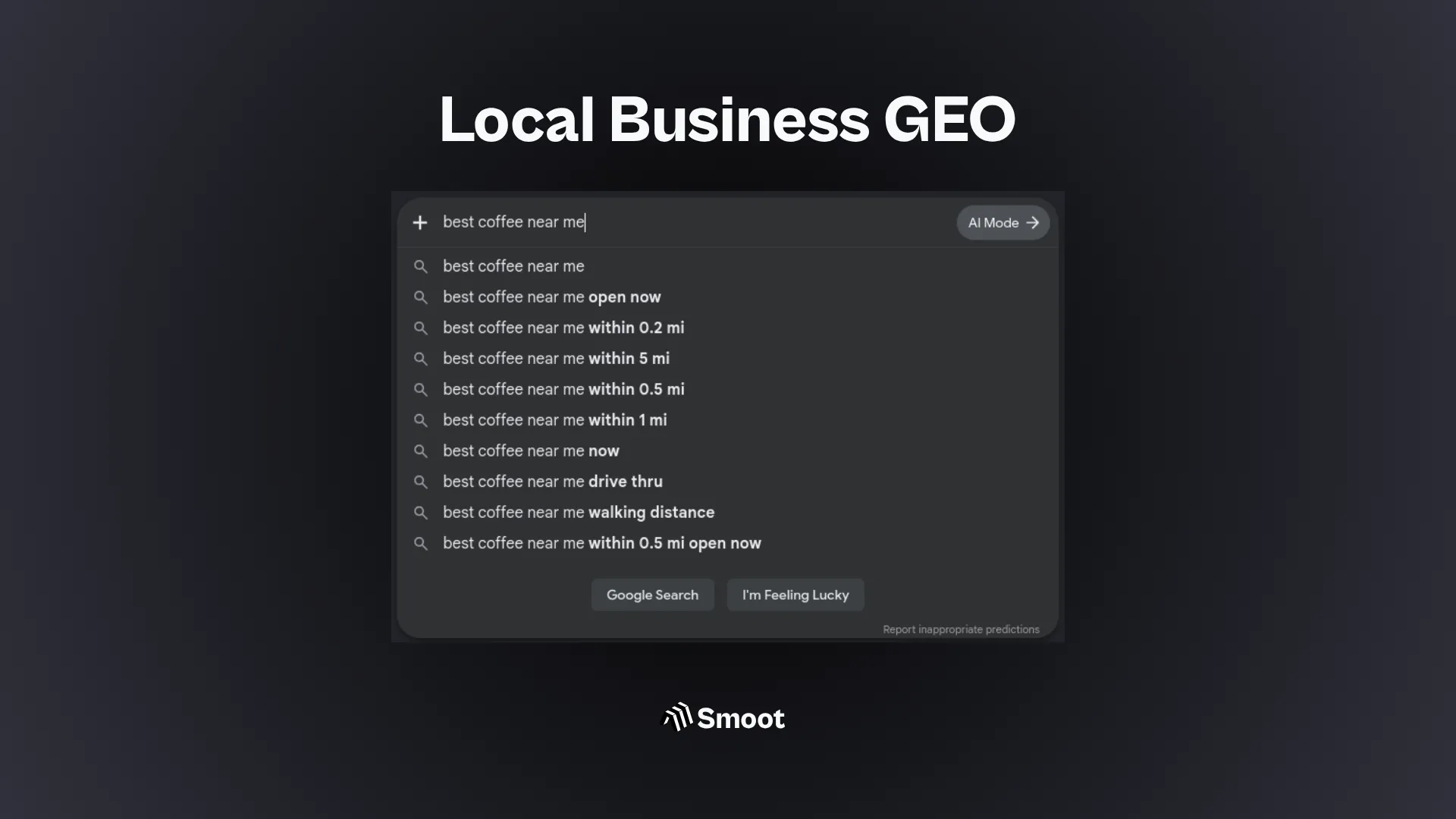
Most local businesses know they need a Google Business Profile. What most don’t know is that GBP helps with Google’s AI features and almost nothing else. ChatGPT doesn’t read GBP. It reads Yelp, TripAdvisor, and whatever Bing’s local index surfaces. Perplexity pulls from a different mix entirely. If you’ve been optimizing for Google’s AI and wondering why you’re invisible on ChatGPT, this is why. Here’s how each engine’s local pipeline works and what to do about it.
TL;DR
- Google’s AI features pull from GBP, Maps, and Google reviews. An optimized GBP directly feeds AI Overviews and AI Mode.
- ChatGPT uses Bing’s local index. Your GBP doesn’t reach it. Yelp, TripAdvisor, and Facebook do.
- Perplexity pulls from a broader mix, including review aggregators and UGC platforms.
- Reviews are the bridge. Every engine reads reviews. The platform the reviews live on determines which engine sees them.
Does my Google Business Profile help with AI search?
Yes, for Google’s AI features.
Google’s own guidance confirms that generative AI responses “can include information about local businesses” drawn from Google Business Profiles. When someone asks Google AI Mode “best pizza near me,” the answer is built from GBP data: categories, hours, reviews, photos, and location.
What matters most in your GBP:
Categories. AI engines use these to match your business to queries. A restaurant listed as “Italian restaurant” gets surfaced for “best Italian food near me.” A restaurant listed only as “restaurant” might not.
Reviews. Volume, recency, and sentiment all factor into whether the AI recommends you. A 4.8 with 200 reviews beats a 5.0 with 12.
Attributes and Q&A. “Outdoor seating,” “wheelchair accessible,” “free wifi” feed directly into AI answers for specific queries.
Responded-to reviews. Businesses that respond to reviews signal active management. AI engines pick this up.
What GBP doesn’t do: it feeds Google’s AI features and nothing else. ChatGPT, Perplexity, and Claude don’t have access to Google’s business database. A fully optimized GBP gets you into AI Overviews and AI Mode. It leaves you invisible everywhere else.
How do I get my business to show up in ChatGPT?
Be visible in Bing’s local index.
ChatGPT retrieves web pages through Bing. The Peec AI Deep Research teardown confirmed that every search ChatGPT runs goes through Bing. For local queries, Bing pulls from its own local index, which draws on a different set of platforms than Google.
Where ChatGPT gets local business information:
Yelp is Bing’s primary local review source. Businesses with active, well-reviewed Yelp profiles appear in ChatGPT’s answers far more often than businesses without them. TripAdvisor dominates for restaurants, hotels, and travel-adjacent local businesses. Facebook business pages with reviews and active posting feed Bing’s local index. Industry-specific directories like Avvo for legal, Healthgrades for healthcare, and Angi for home services are indexed heavily by Bing and surface in ChatGPT for vertical-specific queries.
What to do:
- Claim and optimize your Yelp profile. Add photos, hours, categories, and a detailed description.
- Respond to every review. Bing’s index weights businesses that show active management.
- Identify the 2-3 industry-specific directories Bing indexes for your vertical. Complete your profiles there.
- Add your business to Bing Places. It’s free and directly feeds Bing’s local index, which feeds ChatGPT.
Which review sites matter for AI visibility?
It depends on the engine.
Moz found that reviews shape what LLMs say about local businesses across all major engines. Sentiment, volume, recency, and keyword relevance in reviews all influence whether and how your business gets recommended. But the platform the reviews live on determines which engine reads them.
Which local sources feed which AI engine.
| Source | Google AI | ChatGPT | Perplexity |
|---|---|---|---|
| Google Business Profile | Yes | No | Partial |
| Google reviews | Yes | No | Partial |
| Yelp | No | Yes (via Bing) | Yes |
| TripAdvisor | No | Yes (via Bing) | Yes |
| No | Yes (via Bing) | Partial | |
| Industry directories | Partial | Yes (via Bing) | Yes |
What makes a review useful for AI:
Specificity. “They fixed my AC in under an hour during a heatwave” carries more weight than “Great service.” Specific reviews give AI engines language to use in their answers.
Keywords in reviews. When customers mention your services by name, those terms become associated with your business in the AI’s model.
Recency. AI engines favor fresh information. A steady stream of recent reviews signals that your business is active and the information is current.
Do I need different platforms for different AI engines?
Yes.
Slate HQ documented that each AI platform cites from a different source pool, with citation variance of 5x to 71x for the same brand across platforms. For local businesses, this means optimizing for one ecosystem gives you visibility on one engine.
A quick audit:
- Search for your business on Google AI Mode. Note whether it appears and how it’s described.
- Ask ChatGPT the same query. Compare the answer.
- If you’re missing from one engine, check whether your profiles exist on the platforms that feed it.
- The gap is usually a missing profile, not a quality problem.
Review platform importance by engine.
| Review platform | Google AI | ChatGPT | Perplexity |
|---|---|---|---|
| Google reviews | Essential | Not used | Low |
| Yelp | Not used | Essential | High |
| TripAdvisor | Not used | High | High |
| Not used | Medium | Low | |
| Industry directories | Low | High | Medium |
How do reviews affect what AI says about my business?
Reviews don’t just determine if you’re mentioned. They determine how you’re described.
Moz’s analysis found that LLMs perform semantic analysis on reviews: they extract entities, your services, your location, your attributes, and connect them to sentiment descriptors. A pattern of reviews mentioning “friendly staff” or “long wait times” becomes the AI’s default description of your business.
“LLMs don’t just compare each business’s average rating; they analyze the tone of reviews to understand customer satisfaction and trustworthiness.”
What the AI reads in your reviews:
Positive signals. Words like “impressed,” “above and beyond,” “saved the day” push the AI toward recommending you.
Negative signals. “Disappointed,” “frustrated,” “never again” push it away.
Service mentions. “Brake repair,” “teeth whitening,” “patio installation.” The AI associates these with your business and uses them when answering relevant queries.
Context clues. “During a heatwave,” “on a Sunday,” “for my elderly mother.” These give the AI specificity it can use in answers.
A single detailed 4-star review that describes your service in depth can do more for your AI visibility than ten 5-star reviews that just say “Good.” Encourage customers to be specific. Respond to reviews to add more context the AI can read.
What should I do first?
Local GEO priority matrix.
| Priority | Action | Affects |
|---|---|---|
| Do first | Fill every GBP field: categories, hours, attributes, services, Q&A | Google AI |
| Do first | Claim and optimize Yelp and TripAdvisor profiles | ChatGPT, Perplexity |
| Do first | Add your business to Bing Places | ChatGPT |
| Do next | Identify and complete profiles on 2-3 industry directories for your vertical | ChatGPT, Perplexity |
| Do next | Encourage specific, detailed reviews across Google, Yelp, and TripAdvisor | All engines |
| Do next | Respond to every review on every platform | All engines |
| Ongoing | Monitor how each engine describes you. Search for your category and location on ChatGPT, Perplexity, and Google AI Mode | All engines |
| Ongoing | Keep review volume steady across all platforms. Bursts followed by silence look suspicious | All engines |