Does First-Party Blog Content Help with AI Visibility? It Depends on Your Industry
The types of sources AI cites vary significantly across verticals. We tracked 1,000 prompts across 5 segments to demonstrate.

In this article
- Summary
- Method
- Does blog content help your brand’s GEO?
- How many of the total citations were first-party content?
- How likely was first-party content to appear in any given AI answer?
- What type of first-party content was cited by AI?
- How does prompt intent affect AI citations?
- What this tells us
- What this doesn’t tell us
For some time, the common wisdom has been that the quickest way to improve your AI search presence is to write AI-friendly, first-party content published to your website. However, how effective this content strategy is varies significantly by vertical. We tracked 1,000 prompts split across 5 segments for two weeks and found that first-party content was cited in 73% to 96% of answers related to SaaS, wedding jewelry, and home gym equipment, but appeared in less than 60% of answers related to furniture and smart home security.
Summary
- If your content isn’t being cited, it may be because first-party content is less relevant in your niche. Across all five AI engines, citation patterns varied by segment. The type of product you’re selling impacts the sources AI prefers.
- Prompt intent matters. In segments with few first-party citations, category evaluation prompts like “best sectional sofa under $2000 2026” may primarily cite third-party content, but branded commercial prompts like “best Burrow sectional sofa” still cite first-party content, just not always blog content.
- AI citation patterns in your niche should inform content strategy. Spending lots of time and money on content strategy may have highly variable ROI depending on your particular vertical and segment. It’s important to research current patterns before committing to a strategy.
Method
Prompt set. 1,000 prompts across 5 segments, with each set of 200 split among informational, category evaluation, and branded commercial prompts. The data comes from daily runs over 2 weeks, resulting in 70,000 total scrapes. The prompts were all sourced from real client campaigns based on real-world search and prompt volume data.
AI engines queried. We hit ChatGPT, AI Overview, AI Mode, Gemini, and Perplexity, the AI engines that account for the vast majority of market share in North America.
What we recorded. We extracted all citations and in-line links from each AI answer and measured the occurrence of each domain by type:
- UGC (YouTube, Reddit, Facebook; any media platform that primarily serves user-uploaded content)
- Review (review sites or aggregators dedicated to the niche)
- Publication (publications, both legacy and new, that publish content related to the vertical)
- First-party (content from a brand or service provider in the niche — this can be blog content, documentation for the product, or product pages)
We recorded the percentage of total citations that each domain accounted for, grouped by type, and the likelihood that each domain appeared as a citation in any given prompt in the set.
Limitations. We only measured 200 prompts each for 5 segments. While this data suggests a directional pattern, marketers should be sure to analyze the relevant sources for their own niche before committing to a strategy.
Does blog content help your brand’s GEO?
The impact of first-party blog content on your GEO is highly dependent on your vertical and segment. We found that first-party blog content is a major citation source in segments like SaaS, B2C home gym equipment, and wedding jewelry, but has little impact in others, like furniture.
To determine whether or not first-party content helps your GEO, we examined the percentage of total citations from each source category across the set, as well as the likelihood that a certain type of source would be cited for a prompt. The first is a measure of the portion of total citations, and the second is a measure of the chance that type of source will be cited.
How many of the total citations were first-party content?
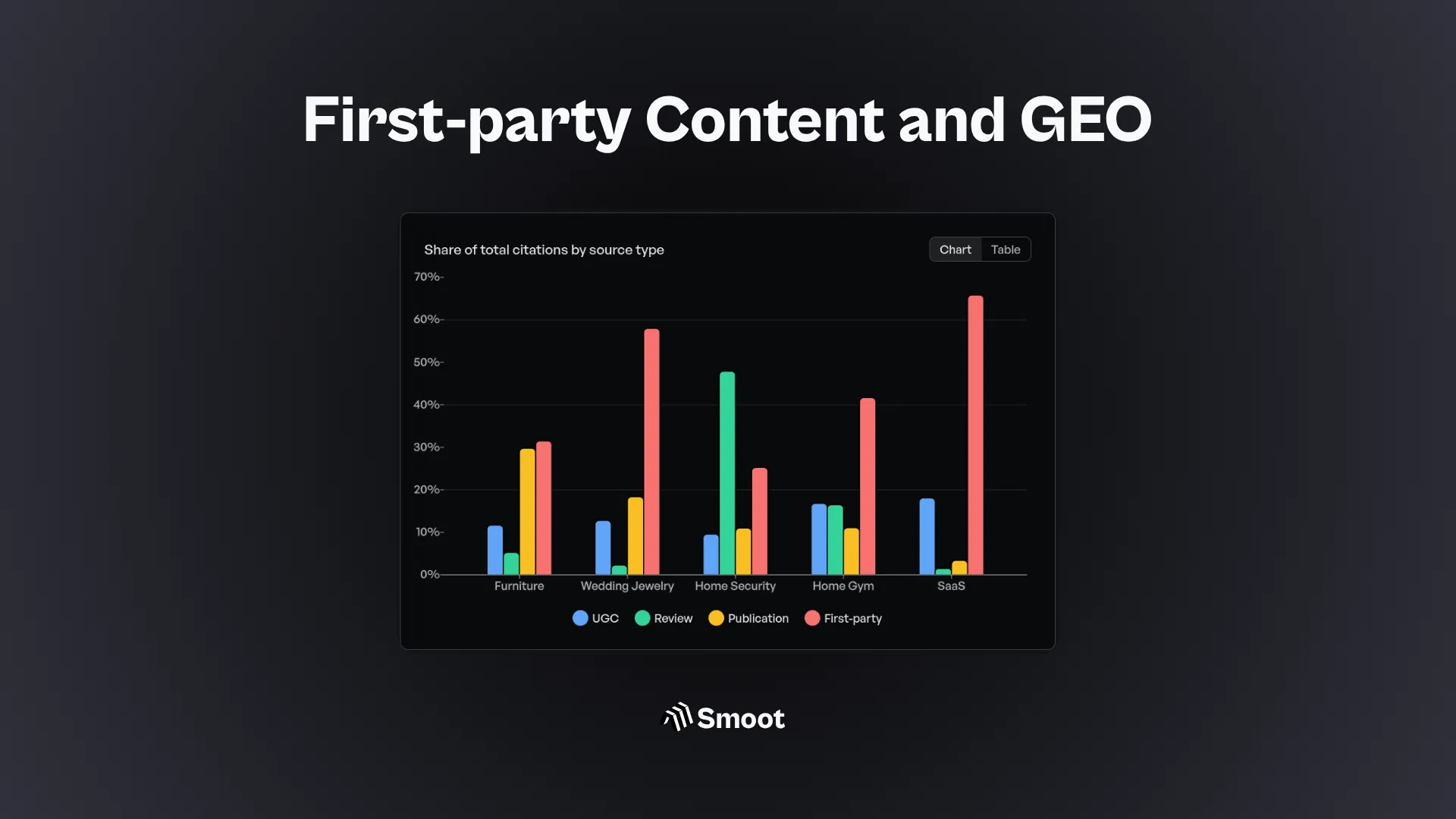
When measuring the percentage of total citations by domain type, we see the following:
Share of total citations by source type
In our data, answers averaged 10 citations, ranging from 4.6 per answer on ChatGPT to 21.5 on AI Mode, and a single answer can cite the same domain multiple times. That means share of total citations can’t distinguish a source type that appears in most answers from one that’s cited heavily in just a few. So we also measured a simpler question: in what share of answers does each source type appear at all?
How likely was first-party content to appear in any given AI answer?
An interesting pattern emerges when we measure the likelihood that first-party content was cited or linked in any given AI answer.
Likelihood of appearing as a citation, by source type
The data tells us that while first-party content is relevant for all segments, it is almost 2x more likely to be cited in segments like SaaS than it is in smart home security or furniture.
Furniture, being a huge, well-established market with coverage from many legacy publications like Architectural Digest, Vogue, Forbes, Business Insider, and GQ, shows a heavy bias towards third-party sources.
Wedding jewelry citations also pull heavily from the publication category, with many of the most-cited individual pages by total citation volume coming from The Knot and Forbes, but the AI answers we measured showed a significant amount of first-party content.
Smart home security citations leaned very heavily on dedicated review sites, of which there are many. Almost every single answer included a citation to Security.org, Safewise, or Safehome somewhere in the list. The likelihood of other categories being cited was roughly equal.
Home gym equipment is a segment with a strong, dedicated community of reviewers, publishing reviews on dedicated sites, UGC platforms, and traditional publications. Two of the most-cited individual pages were from dedicated sites like BarBend and GarageGymReviews. Nevertheless, we saw first-party content appear in AI citations 73% of the time. We observed AI using first-party content as a starting point and then refining its recommendations based on third-party content.
SaaS-related AI answers almost always included first-party content, and frequently incorporated UGC. In many cases, informational queries resulted in citations to authoritative third-party publications, specifically Search Engine Journal and arXiv.org.
Of course, 57.7% of citations being first-party content is still substantial. However, a more compelling picture emerges when we examine what type of first-party pages were cited.
What type of first-party content was cited by AI?
We divided the content into three rough categories.
- Product / Catalog. These are product or product category pages that the AI is using to learn about specific products directly.
- Blog Content. Blog content is exactly what you imagine, inbound SEO-focused content relevant to the brand’s target audience.
- Resources & Tools. This category is clear in some cases and less so in others. Real examples in this category from our data include home gym design tools, free tool SaaS lead magnets, and sizing or buying guides for jewelry or furniture. If the content leaned more technical or was interactive, we put it in this category.
First-party citation mix by content type
For furniture, almost every first-party citation was to a direct product or catalog page, not to blog or resource content. The AI would seek out the brand’s site in order to gather specific information about a product or lineup, but largely ignored branded content outside of that.
For wedding jewelry—somewhat surprisingly for a legacy segment—blog content mattered substantially. Product information was important, but AI frequently chose to cite first-party content.
SaaS, rather unsurprisingly, lives or dies by its blog and resources content. AI almost exclusively learns about SaaS products through first-party content, whether that be your own content or a competitor’s comparison page.
How does prompt intent affect AI citations?
In the segment where first-party content was less relevant and product pages were the most cited first-party content type, branded commercial queries were far more likely to elicit first-party citations than category or informational queries.
The breakdown on which type of queries resulted in a first-party citation is below:
First-party citation rate by query intent
For the segments with lower incidence of first-party citations, like furniture and smart home security, we see a significant tilt towards commercial and branded queries.
In the furniture data, we saw a tendency for AI to seek out product pages and lineups in response to commercial queries like “Which Burrow sofa is best” or “Where else can I buy furniture online besides Wayfair and Amazon?”
In the smart home security data, it meant that prompts like “Is Reolink reliable?” or “DIY alternatives to ADT home security” were more likely to result in first-party content citations, whether the brand’s own article or a competitor’s, but the gap is not as large as in furniture.
The other categories saw a more even mix of first-party citations across intents. AI was more likely to mix and match first-party and third-party sources across the board.
What this tells us
First-party content, especially blog or resources content, does have a positive impact on your site’s GEO, but the ROI is significantly influenced by the product you’re selling.
If you’re a marketer putting together a GEO strategy, you should absolutely research the citation patterns in your vertical before you commit to anything. Knowing the relative impact of first-party content in your niche will help you decide where to allocate your resources.
If first-party blog and resources content is lower-impact, you may want to dedicate more time to:
- Aligning and enriching product details on your site and across any retailers
- Validating and enriching structured data on your product and category pages
- Implementing UPC and agentic ecommerce best practices
If first-party blog content is high-impact, you may want to focus more on:
- Strategizing clusters of related content to build topical authority
- Fine-grained targeting of fan-out queries to increase your content’s exposure to certain high-value prompts
- Improving overall EEAT signals in your content and revamping any content in an AI-friendly, answer-first style
In neither case should you totally abandon one focus for the other, but informing your strategy with data can help you maximize the return on your effort.
What this doesn’t tell us
- Whether these variations show up across large swaths of the market. This data is largely directional. We only measured 5 segments every day for a period of two weeks. These discrepancies might average out over much larger sets of prompts. But we drew these conclusions from real client data tracking real-world brands using real-world user prompts and search queries.
- Whether this is correlation or causation. We can’t tell if the discrepancies here are due to AI preferences or brand strategy. Some brands may have simply executed excellent GEO strategies and published great, relevant content, pushing the numbers up in their niche. Vice versa, some niches might not yet have many large brands focusing on AI visibility, or prefer to leave it to their established presence in third-party sources.
- Whether any of this will stay the same. AI citation patterns are changing all the time due to changes in the infrastructure and underlying models. These patterns could flip at any moment, which is yet another reason it’s important to gather your own data before launching a GEO campaign.
Want help creating your own GEO strategy or have any questions about the article? Feel free to reach out, we’d love to hear from you.