We Tracked 300 Pages to See When AI Starts and Stops Citing New Content
Each AI model has a distinct curve

In this article
- TL;DR
- Methodology
- Three engines, three completely different curves
- AI Mode spikes, then keeps shedding citations
- ChatGPT climbs steadily and maintains citations for longer
- Perplexity lands between the two
- Domain Rating correlates with citation speed, but modestly
- One in five pages was never cited by anything
- What this study does and doesn’t prove
- How to use this data
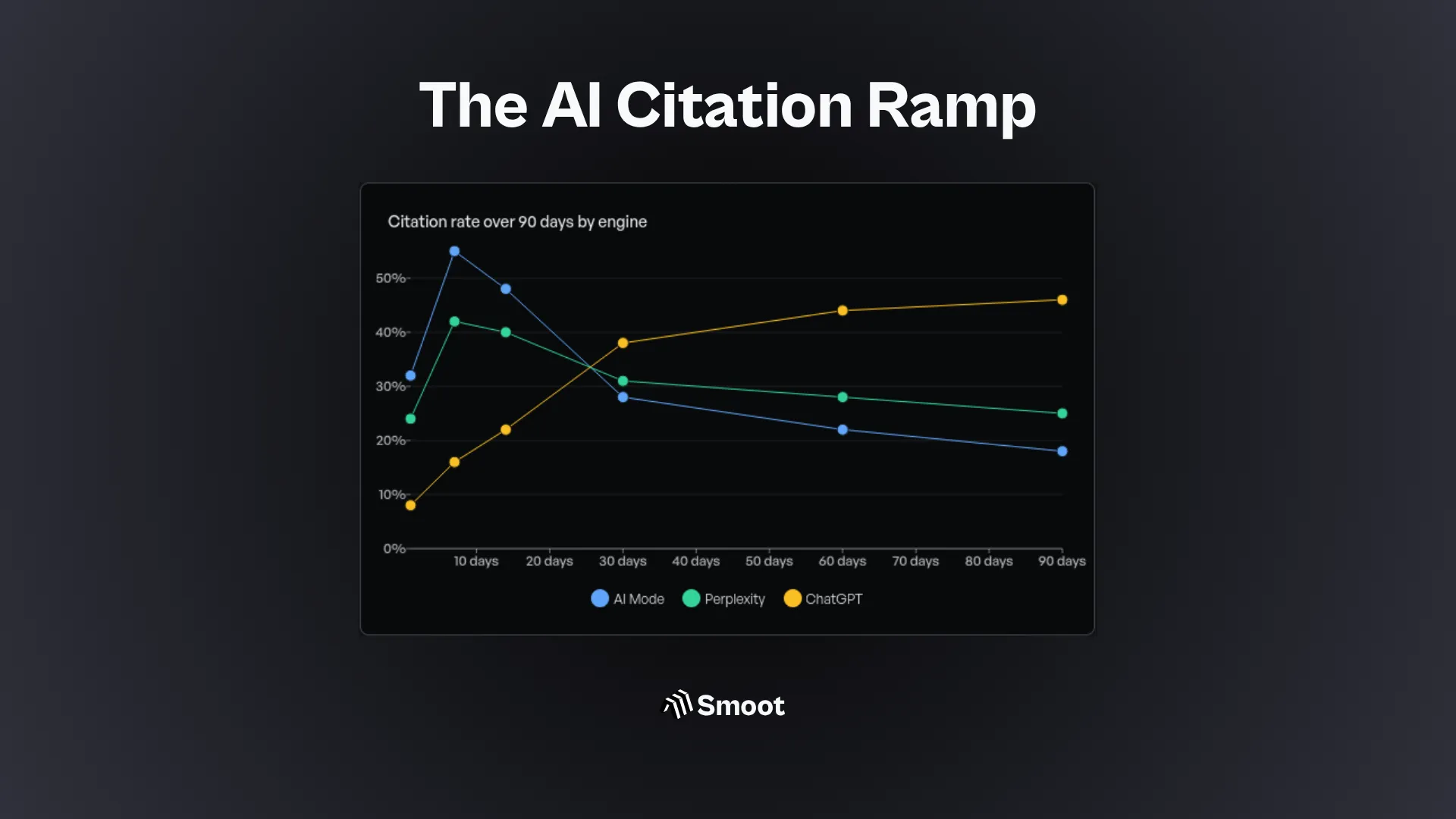
Google AI Mode, ChatGPT, and Perplexity follow three completely different citation curves. AI Mode spikes fast and decays. ChatGPT builds slow and stays. Perplexity forms a rounded hill in between. We tracked 300 pages across 60 domains for 90 days to map all three, and by the end, AI Mode had shed two-thirds of the pages it initially cited while ChatGPT had nearly doubled its count.
Semrush first surfaced the split between AI Mode and ChatGPT in December 2025. They published 81 pages on their own blog at Authority Score 84 and tracked citations for 30 days. AI Mode hit 59% at its peak, then shed citations continuously through Day 30. ChatGPT started at 10% and kept climbing. We tracked 300 pages across 60 domains for 90 days, adding Perplexity to the mix and using domains of varying strength. The curves didn’t converge.
TL;DR
- Google AI Mode: 32% of pages cited within 24 hours, peaked at 55% on Day 7, then decayed to 18% by Day 90
- ChatGPT: 8% on Day 1, climbed steadily to 46% by Day 90, never declined
- Perplexity: 24% on Day 1, peaked at 42% on Day 7, settled at 25% by Day 90
- 22% of pages received zero citations from any engine across the full 90 days
- Domain Rating showed a modest correlation with faster citation, but engine choice was a much larger variable
Methodology
We identified 300 pages across 60 domains, with five pages per domain, all published within a single seven-day window. We selected pages with a mix of informational and commercial content and similar structural characteristics: clear H2 and H3 headings, author bios, and a summary section at the top.
We grouped the domains into three tiers by Ahrefs Domain Rating: high (DR 60 and above), medium (DR 35 to 60), and low (DR below 35).
We tracked the pages across ChatGPT, Perplexity, and Google AI Mode. We excluded AI Overviews because it uses index-based retrieval and operates differently from real-time retrieval engines. For 90 days, we queried 200 topic-relevant prompts every 72 hours and recorded which pages appeared, in what position, and at which URL.
A few things this study doesn’t capture. We measured citation presence, not citation position. A page cited ninth in a list of ten has a different impact than one cited first. We didn’t control for content quality differences between domains. The domain-tier sample is moderate. The curves tell you about direction and shape, not precise benchmarks for any individual page.
Three engines, three completely different curves
Citation rate over 90 days by engine
Our AI Mode and ChatGPT numbers run slightly below Semrush’s 81-page study because our sample included domains of varying strength. Semrush tested a single domain at Authority Score 84 and saw AI Mode peak at 59% instead of our 55%. The curve shapes are identical.
By Day 30, the three engines had nearly converged: AI Mode at 28%, Perplexity at 31%, ChatGPT at 38%. Anyone measuring at that point would conclude the differences between engines were modest by then. But between Day 30 and Day 90, AI Mode fell to 18% while ChatGPT climbed to 46%. The gap more than doubled after the point where Semrush stopped tracking.
AI Mode spikes, then keeps shedding citations
AI Mode cited 32% of pages within 24 hours. It peaked at 55% on Day 7. Then it shed citations continuously, dropping to 18% by Day 90, a two-thirds reduction from peak.
The pattern is consistent with how AI Mode retrieves content. Google’s AI optimization guide documents that a single user question triggers multiple related sub-queries. A question about fixing a patchy lawn might trigger searches for grass seed types, fertilizer schedules, and common lawn diseases, all at once. Over time, the set of sub-queries shifts as the engine refines its understanding of the topic. A page that matches today’s fan-out might not match tomorrow’s.
Semrush noted the same volatility in their 30-day window and wrote that there was “nothing we can do to control this.” Our 90-day data shows the pattern doesn’t settle. AI Mode keeps re-evaluating its source pool and rotating pages in and out as its fan-out queries change. A page highly visible on Day 7 may be gone by Day 30, and the reason has nothing to do with the content getting worse.
ChatGPT climbs steadily and maintains citations for longer
ChatGPT started at 8% on Day 1. It reached 16% by Day 7, 38% by Day 30, 44% by Day 60, and 46% by Day 90. The curve flattens around Day 60 but doesn’t turn down.
“Once ChatGPT cited pages, they generally remained there. And over time, new pages were added.”
That observation comes from the Semrush study, which tracked citations for 30 days. We saw the same pattern continue through Day 90. ChatGPT keeps citing pages it has already decided to trust while adding new ones. The result is a steady accumulation curve.
Part of this comes from how ChatGPT combines retrieval with its training data. Ahrefs’ analysis of 17 million citations found AI assistants cite content 25.7% fresher than Google, and ChatGPT shows the strongest freshness preference among them. It selects newer content, but once selected, it holds on. Separately, GrowByData’s 2026 research found the freshness boost for content under 30 days old decays over 60 to 90 days.
A page invisible on ChatGPT at Day 7 may appear at Day 30. A Day-7 audit undercounts actual ChatGPT visibility by a factor of two or three.
Perplexity lands between the two
Perplexity cited 24% of pages on Day 1, faster than ChatGPT’s 8% and slower than AI Mode’s 32%. It peaked at 42% on Day 7 alongside AI Mode, then decayed more gently: 31% at Day 30, 25% at Day 90. A 40% reduction from peak, compared to AI Mode’s 67%.
GenPicked’s citation lag research found Perplexity picks up blog content within 24 to 48 hours. Perplexity uses real-time retrieval and re-evaluates sources on every query rather than building a stable source graph like ChatGPT. But its broader citation pool means individual pages are less likely to be rotated out entirely than on AI Mode. Of the three engines, Perplexity’s Day-30 number tracks most closely with its long-term behavior.
Domain Rating correlates with citation speed, but modestly
We grouped domains into three tiers by Ahrefs Domain Rating (high, medium, low) and checked whether any relationship with citation speed appeared.
Higher-DR domains get cited faster, but the gap is modest
A relationship is there. High-DR domains were cited roughly 1.3 times more than low-DR ones at peak on AI Mode and Perplexity. ChatGPT showed a wider spread early, 18% versus 7%, but narrowed to 1.4 times by Day 90.
But the correlation is weak enough that we can’t call it causal. High-DR domains also tend to have faster servers, better internal linking, and more structured content. Any of those variables could explain the gap. And the effect is dwarfed by engine choice. The gap between AI Mode and ChatGPT at Day 7, 55% versus 16%, is about ten times larger than the gap between high-DR and low-DR domains within either engine.
AI engines do not query a DR database. They form source judgments from what they encounter during retrieval: how often they have seen a domain cited, how its content is structured, whether its claims are corroborated elsewhere. Domain recognition is a byproduct of those signals, not an input. The data suggests a relationship, but a faint one.
One in five pages was never cited by anything
Across 90 days and all three engines, 22% of pages received zero citations. By DR tier: high-DR 8%, medium-DR 18%, low-DR 38%. Being indexed did not guarantee being cited, even on strong domains.
At the other end, only 19% of pages appeared in all three engines. Another 41% appeared in at least two. For context, Averi’s analysis of 680 million citations found 11% domain-level overlap between ChatGPT and Perplexity. Page-level overlap is tighter, as you would expect. Engines that agree on a domain do not necessarily agree on which page to cite.
Semrush found that even with an AS 84 domain, 41% of their pages were never cited by AI Mode at peak. Our mixed-domain sample landed at 22% never cited across all three engines combined. A meaningful portion of published content never enters the AI citation pool, and the risk concentrates on lower-DR domains.
What this study does and doesn’t prove
Each engine has a distinct citation ramp shape that persists through 90 days. AI Mode spikes and decays, ChatGPT climbs and holds, and Perplexity forms a rounded hill. These shapes match Semrush’s 30-day data. Domain Rating shows a modest correlation with faster citation, but engine choice is the dominant variable. Roughly one in five pages is never cited by any engine.
The ramp shapes describe aggregate behavior. Any individual page may follow a different path. We measured citation presence, not position, and a page cited ninth has different impact than one cited first. The domain-tier correlation is observational. We did not control for content quality, server speed, or internal linking. The 90-day window shows where ChatGPT stabilizes but does not tell us how long citations persist beyond that. Pages published on domains with no prior AI citation history may behave differently than pages on already-cited domains.
How to use this data
If you do nothing else:
- Do not measure AI visibility at a single point in time. A page invisible on ChatGPT at Day 7 may appear at Day 30. A page visible on AI Mode at Day 7 may be gone by Day 30. When you measure changes what you see.
- Track per-engine, not on aggregate. The curves are different enough that a combined score hides where you actually appear. A brand that looks invisible on ChatGPT may be performing fine on Perplexity.
- Wait at least 30 days before drawing conclusions about ChatGPT visibility. The ramp is slow. A Day-7 audit undercounts your actual footprint.
When you have more time:
- Segment your monitoring by engine and by page age. A page published 90 days ago should be measured against different expectations than one published last week. The expected citation rate changes with time.
- Do not over-index on domain authority as a GEO lever. The correlation is real but small. Content structure, original data, and clear extractability matter more.