ChatGPT Overlaps With Google 10% of the Time. In Health, It Drops to 6%.
We tracked 3,000 prompts across 6 industries. The citation gap is bigger in health and smaller in e-commerce.

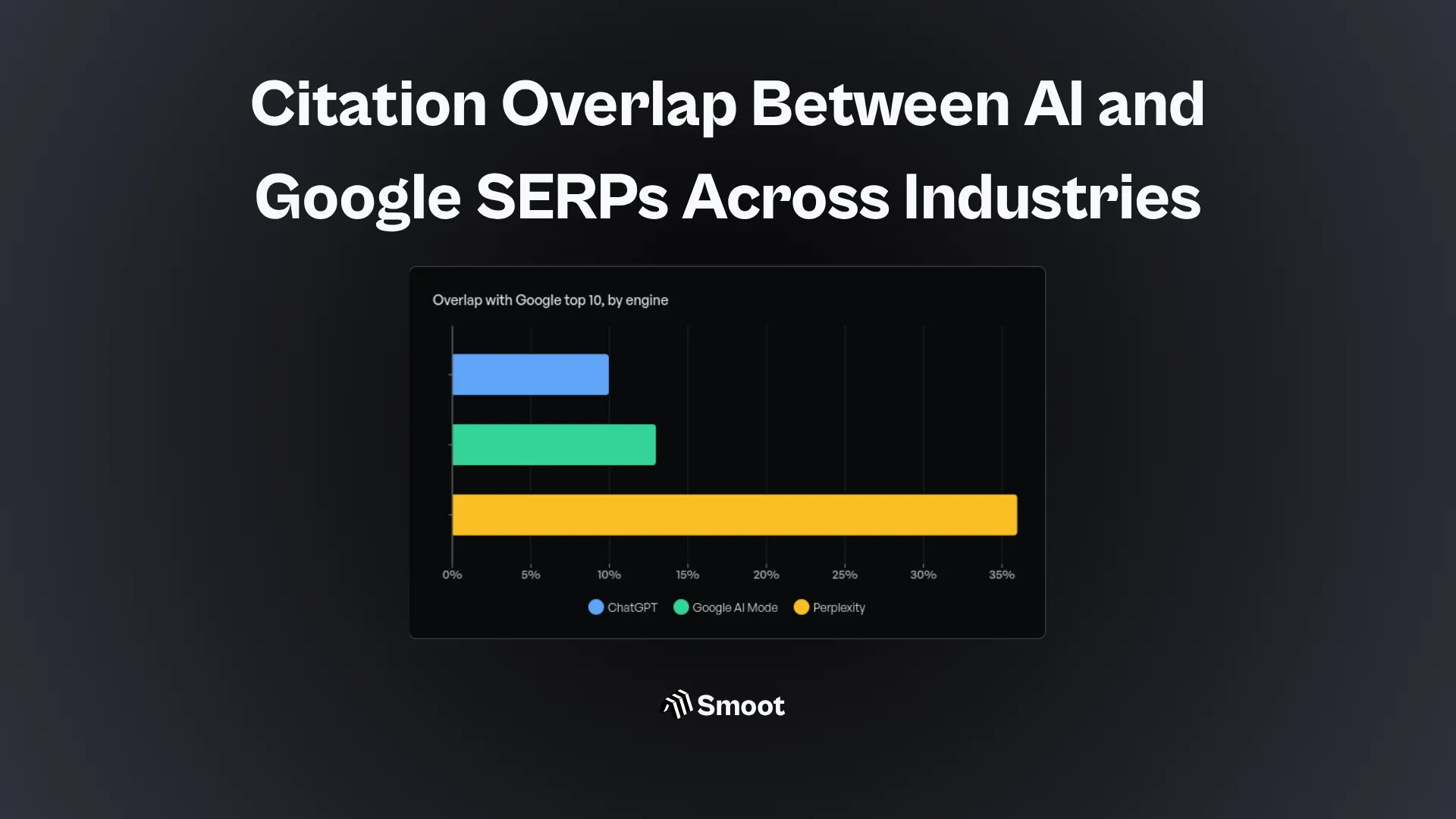
If you rank #1 on Google, you might assume you’ll show up in AI answers too. You won’t, at least not reliably. We ran 3,000 prompts across six industries and three AI engines and found that the overlap between Google’s top 10 and AI citations averages just 10% for ChatGPT, 13% for Google AI Mode, and 36% for Perplexity. Health companies face the widest gap. E-commerce companies face the narrowest. But across every industry, the gap between the best and worst engine is larger than anything your industry does to the numbers. If you’re only tracking one engine, you don’t know whether your rankings are carrying over or not.
TL;DR
- ChatGPT and Perplexity share only 11% of cited domains. They cite from fundamentally different source pools.
- Engine is the biggest variable. ChatGPT overlap with Google: ~10%. AI Mode: ~13%. Perplexity: ~36%.
- Industry compounds the effect. Health companies see the widest gap across all engines. E-commerce companies see the narrowest.
- Domain overlap is higher than URL overlap. ChatGPT cites the same websites as Google roughly 3x more often than the same pages.
- Ranking #1 on Google doesn’t guarantee AI visibility. Across all engines and industries, the #1 organic result appeared in AI citations for the same prompt less than half the time.
Methodology
Prompt set. 3,000 prompts across six verticals, 500 per vertical: health, finance, B2B SaaS, local services, travel, e-commerce. Mixed informational and commercial queries drawn from common category search patterns.
Engines. ChatGPT, Perplexity, Google AI Mode. We excluded Google AI Overviews because they closely mirror the SERP. Ahrefs found 76% of AI Overview citations come from the top 10 and they behave differently from the other engines.
What we recorded. For each prompt, we captured Google’s top 10 organic results and the URLs cited by each AI engine. We measured strict URL overlap: what percentage of AI-cited URLs also appeared in Google’s top 10 for the same prompt. For ChatGPT, we also measured domain overlap.
A note on limitations. Per-industry sample is 500 prompts. Enough for directional patterns, not precise benchmarks. We didn’t control for content quality, domain authority, or how well pages matched the AI’s fan-out queries.
Finding 1: The Engine Gap Dwarfs Everything
Perplexity overlaps with Google’s top 10 at 3.6x the rate of ChatGPT. AI Mode sits between them. If you’re only tracking one engine, you’re measuring a fraction of your actual AI footprint.
The architecture explains the gap. Perplexity is built to cite. It runs real-time web searches and returns sources for nearly every claim. Its citation pool closely resembles Google’s. Google AI Mode uses query fan-out, pulling from related searches rather than the exact prompt, which reduces overlap even though it uses Google’s own index. ChatGPT relies more on its training data and its own retrieval pipeline.
This isn’t just our finding. Ahrefs measured ChatGPT’s overlap with Google at 8-10% across 15,000 queries. Moz found AI Mode at 12% across 40,000. Slate HQ documented citation variance of 5x to 71x for the same brand across platforms. Averi’s analysis of 680 million citations found only 11% domain overlap between ChatGPT and Perplexity.
“A brand visible on one platform may be invisible on another.”
What this means: if you only track one engine, you don’t know whether your Google rankings are translating. A brand that looks invisible on ChatGPT might be performing fine on Perplexity, and vice versa. Most GEO work helps across all engines. But measurement has to be per-engine, or the aggregate number hides where the gaps actually are.
Overlap with Google top 10, by engine
Finding 2: Industry Compounds the Engine Gap
So the engine matters most. But does your industry make it better or worse?
We measured overlap by vertical within each engine. The pattern was the same across all three: health always the lowest, e-commerce always the highest.
| Vertical | ChatGPT | Perplexity | AI Mode |
|---|---|---|---|
| Health | 6% | 28% | 9% |
| Finance | 8% | 31% | 10% |
| B2B SaaS | 9% | 35% | 12% |
| Local services | 11% | 38% | 14% |
| Travel | 12% | 40% | 15% |
| E-commerce | 13% | 43% | 16% |
The gap between health and e-commerce is 7 to 15 percentage points depending on the engine. Real, but secondary. Compare that to the engine gap: 10% for ChatGPT vs. 36% for Perplexity. The industry effect is a modifier. The engine effect is the main event.
Why health and finance have wider gaps. Google’s Search Quality Rater Guidelines apply heightened standards to “Your Money or Your Life” topics. AI engines inherit this. When answering a health question, they reach past commercial results toward institutional sources: government health agencies, academic medical centers, peer-reviewed journals. Those sources don’t appear in the commercial top 10. Moz found that institutional medical domains dominate AI Mode citations for health queries. The AI selects from a different candidate pool than the SERP.
Why e-commerce and travel have narrower gaps. Product pages, review sites, and booking platforms serve both Google and AI engines well. Structured data, pricing, and specifications are directly relevant to both. The same page that ranks for “best running shoes” is often the page an AI engine wants to cite. There’s less tension between what ranks and what’s citable.
A health company tracking only ChatGPT sees 6% overlap and panics. An e-commerce company tracking only Perplexity sees 43% and gets complacent. Both are missing the full picture. The gap between the best and worst engine is larger than anything your industry does to the numbers, and if you only track one, you don’t know which end of it you’re on.
Overlap with Google top 10, by industry and engine
Finding 3: ChatGPT Cites the Same Sites But Different Pages
Even when ChatGPT and Google agree on which domains to cite, they often disagree on which pages.
Across our 3,000 prompts, ChatGPT cited domains that ranked in Google’s top 10 roughly 32% of the time. But the same URL appeared only 10% of the time. It trusts the same websites 3x more than the same pages.
Ahrefs found the same pattern: 31.8% domain overlap vs. 10% URL overlap across 3,300 short-tail queries.
This suggests ChatGPT is selecting pages based on different criteria than Google. It may favor pages that answer fan-out sub-queries rather than the original prompt, or pages with structural qualities Google doesn’t weight as heavily.
The practical implication: one page ranking well isn’t enough. You need cluster coverage. Multiple pages on your domain covering related angles, so that when ChatGPT fans out across sub-queries, it finds a page of yours that fits.
ChatGPT domain vs. URL overlap with Google top 10
What This Does and Doesn’t Prove
What it does prove.
Engine choice is the largest variable in whether Google rankings translate to AI citations. Perplexity consistently shows 3-4x higher overlap than ChatGPT. This is measurable and consistent with published research from Ahrefs, Moz, Averi, and Slate HQ. Industry compounds the engine effect. Health and finance consistently show wider gaps than e-commerce and travel. The mechanism is grounded in documented YMYL standards and AI source selection behavior.
What it doesn’t prove.
The per-industry percentages are from a 500-prompt-per-vertical sample. They show a directional pattern, not precise benchmarks. Content quality, domain authority, and how well each page matches the AI’s fan-out queries all affect citation probability independently of industry. We didn’t measure or control for these.
What to Do About It
If you do nothing else:
- Track per-engine, not aggregate. A brand that looks invisible on ChatGPT might be performing fine on Perplexity, and an aggregate score hides both. The tactics are the same across engines, but the measurement isn’t.
- Don’t assume ranking #1 helps. Across all engines and industries in our data, the #1 Google result appeared in AI citations for the same prompt less than half the time. Rank tracking is not citation tracking.
- If you’re in health or finance, expect a wider gap. Your Google rankings are less predictive of AI visibility than they would be in e-commerce or travel. Budget for off-site work: getting cited by the institutional sources AI engines trust in your vertical.
When you have more time:
- Build topic clusters, not single pages. ChatGPT cites your domain 3x more than your specific page. Cover related angles and sub-topics so the engine has more pages of yours to choose from.
- Track per-engine, not aggregate. The 5x to 71x visibility gaps that Slate HQ documented mean an aggregate score hides where you’re invisible. Segment your monitoring.
- Map the institutional sources AI trusts in your vertical. For health, it’s .gov and academic domains. For B2B SaaS, it’s G2, Gartner, and documentation hubs. These are the sources pulling citations away from the commercial SERP. Get referenced by them.