What causes "Ghost Citations"? We Tracked 200 Prompts in an Ecommerce Vertical for a Month.
Ghost citations are the norm, not the exception.

Most AI citations don’t name the brand they’re citing. We tracked 200 prompts about robot lawn mowers across five engines for a month and found that 58% of the time, the source link was there and the brand name wasn’t. Awareness-stage queries (“best robot lawn mower,” “best robotic mower for large lawns”) were the worst offenders at 71%. Running the same prompts daily for four weeks didn’t change anything. A citation that was ghosted in week 1 was still ghosted in week 4.
TL;DR
- 58% of citations across 200 prompts and 5 engines were ghost citations. The source was linked but the brand was never named.
- Awareness-stage queries had the highest ghost rate at 71%. Decision-stage queries had the lowest at 43%.
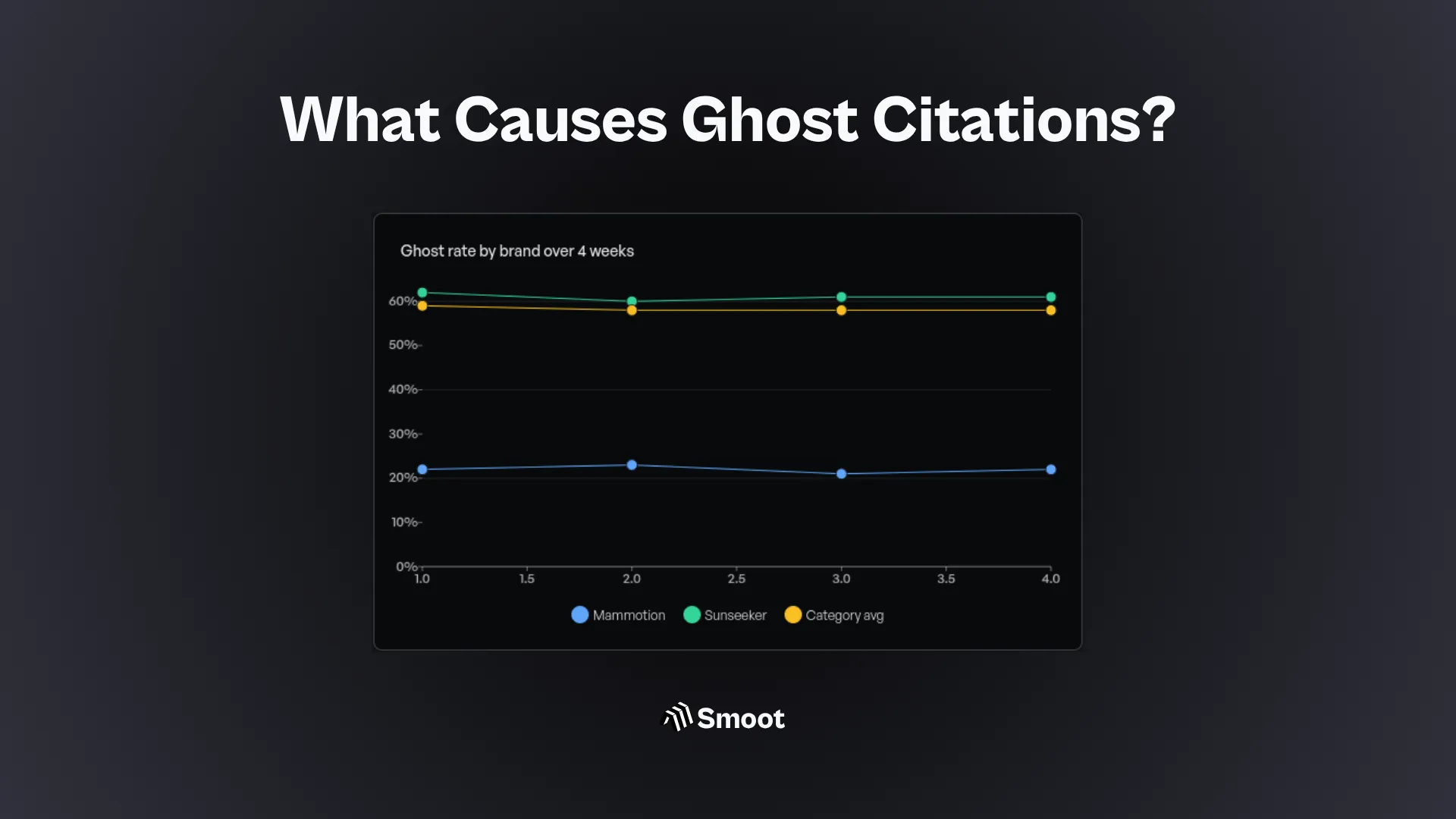
- Mammotion had a ghost rate of 22%. Sunseeker had a ghost rate of 61%. The gap between them didn’t move over four weeks.
- Multiple unique citations from the same brand’s source seems to have a significant impact on mention likelihood. A third-party citation that includes the brand improves the chance of a mention even moreso.
- Brands that were both cited AND mentioned reappeared in 36% of subsequent runs. Brands that were only cited reappeared in 12%.
Methodology
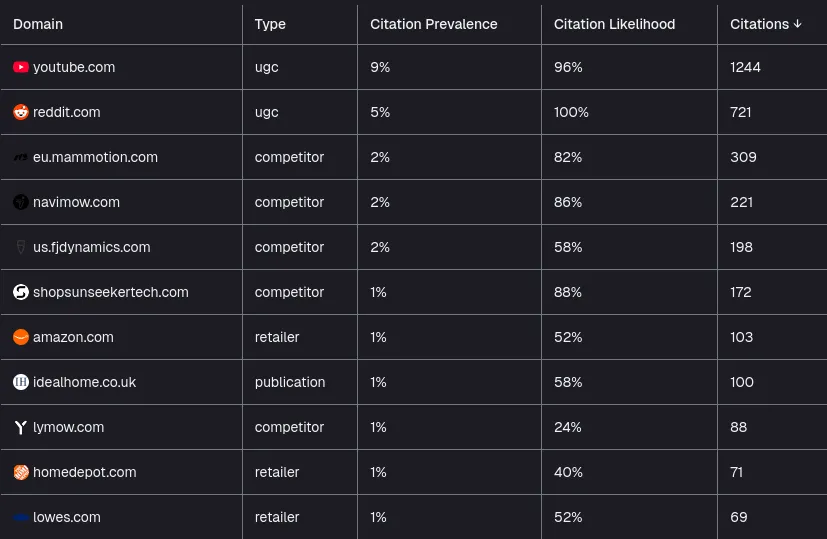
We tracked 200 prompts about robot lawn mowers across ChatGPT, Perplexity, Google AI Mode, Google AI Overviews, and Gemini. Brand blogs account for a significant share of AI citations in this category, more than in most other e-commerce verticals, which made it a useful place to study the gap between being cited and being named. Dedicated review sites and UGC like Reddit and YouTube still dominated citations, but many brand domains were among the most cited.
We tracked 12 brands in the category, split across three intent categories: awareness (category research, “best robot lawn mower”), consideration (comparisons, “Husqvarna vs. Mammotion”), and decision (pricing, reviews, “Mammotion Luba 2 price”).
Each prompt was queried daily for four weeks. AI engines give different answers on nearly every run, so a single query per prompt produces unreliable data. For each response, we tagged whether a brand was cited (source link present), mentioned (brand name in the answer text), both, or neither. A ghost citation means cited but not mentioned.
Three out of five citations are ghost citations
Across all 200 prompts, 5 engines, and 4 weeks, 58% of citations were ghost citations. The source link appeared in the response. The brand name did not.
Kevin Indig’s analysis of 3,981 domain appearances found a 62% ghost rate across a broader set of industries and query types, suggesting either a slightly lower rate of ghost citations in commercial queries or what amounts to a rounding error.
The rate was consistent across engines. ChatGPT, Perplexity, AI Mode, AI Overviews, and Gemini all landed within a few points of the 58% average. The phenomenon isn’t specific to one retrieval architecture. AI engines pull from sources to construct a response, and naming the source is a separate decision from using it.
If you measure AI visibility by tracking citations alone, you’re overcounting. Nearly three out of five citations don’t tell the user who provided the information.
The queries where it matters most are the worst
Awareness-stage queries (“best robot lawn mower,” “best robotic mower for slopes,” “top rated robot mowers”) had a ghost citation rate of 71%. These are the queries where a potential customer is forming their mental shortlist. The AI pulls data from brand pages to build its answer but doesn’t tell the user whose data it’s using.
Ghost citation rate by query intent
Seer Interactive’s research on ghost citations describes the mechanism: LLMs decide which brands to name from parametric memory first, then retrieve sources to support those choices. The citations are “the bibliography, not the brainstorm.” For an awareness query, the model reaches for the brands it already associates with the category. Those brands get named. Other brands can still get cited if their content is useful, but they rarely get named.
For a decision-stage query, the dynamic shifts. Someone asking about Luba 2 pricing already knows Mammotion exists. The model is more likely to name the brand because the query itself contains it or implies it. The ghost rate drops accordingly.
If you only track your brand’s visibility on decision-stage queries, you’re seeing the rosiest version of the data. The queries where you’re being introduced to new buyers are the ones where your name is most likely to be absent.
Two brands, two completely different ghost rates
The aggregate numbers hide how much individual brands vary. Mammotion and Sunseeker both appeared regularly in AI responses for robot lawn mower queries, but their ghost rates looked nothing alike.
Both Sunseeker and Mammotion were major contributors of citations across the prompt set, appearing as citations in the majority of prompts. However, some key differences emerged.
Mammotion appeared in more than 80% of prompts. When Mammotion was cited as a source, the brand was also named in the answer text 78% of the time, a ghost rate of just 22%. Mammotion was the most-cited brand domain by citation total after YouTube and Reddit, with more than 400 distinct URLs from mammotion.com appearing across the citation pool. The brand also had heavy third-party presence: UGC platforms, review blogs, and comparison sites frequently named Mammotion alongside its own content.
Sunseeker’s sources were also cited in a large number of prompts, nearly 90%. Its domain was cited regularly, with 142 own-domain source URLs across the month. But when Sunseeker was cited, the brand was mentioned only 39% of the time, a ghost rate of 61%. Sunseeker had less third-party reinforcement. Its brand name appeared in fewer external contexts, which meant the AI encountered it less often outside of sunseeker.com.
Additionally, something odd jumps out about the data. While Sunseeker was just as or slightly more likely to appear as a citation, it accounted for less of the total number of citations by a large margin. This means that when Mammotion was being cited, it was almost always multiple sources being cited in one response. Mammotion’s own content was dominating the total volume of unique sources compared to Sunseeker, accounting for a whopping 2% of all sources cited.
The gap between the two brands was visible across all three query intent categories, but it was widest for awareness queries. When someone asked “best robot lawn mower,” Mammotion was named in the answer nearly every time it was cited. Sunseeker’s content was used regularly for the same queries, but the brand name rarely made it into the answer.
The gap didn’t move
We tracked both brands weekly for four weeks. Neither ghost rate changed.
Ghost rate by brand over 4 weeks
Mammotion’s ghost rate stayed around 22%. Sunseeker’s stayed around 61%. Being cited repeatedly didn’t close the gap. The AI didn’t learn Sunseeker’s name through repeated exposure to its content.
A ghost citation is a stable outcome, not a transitional state. If your content is producing ghost citations today, it will keep producing ghost citations unless something about the brand’s broader presence changes.
Why Mammotion got named
The difference showed up in how the two brands were cited. For prompts where Mammotion was mentioned, its own content and third-party content naming Mammotion were frequently cited together in the same response. A review blog naming Mammotion and a mammotion.com product page would both appear as sources. The brand name reached the AI through multiple channels simultaneously.
Sunseeker’s citations were more isolated. When sunseeker.com was cited, it was often the only source naming the brand in that response. The AI pulled data from the page but didn’t encounter the brand name anywhere else in the same retrieval pass.
We measured how often each brand was mentioned under two conditions: when its own domain was cited alongside third-party content naming the brand, and when its own domain was cited alone.
Brand mention rate by citation pattern
Co-citation dramatically increased mention probability for both brands. When Mammotion’s own content and a third-party source naming Mammotion were cited together, the brand was mentioned 91% of the time. When mammotion.com was cited alone, the mention rate dropped to 52%. Sunseeker followed the same pattern at lower absolute numbers: 64% with co-citation, 18% without.
The gap between the two brands came down to how often they got co-cited. Mammotion’s content was accompanied by third-party reinforcement in most responses. Sunseeker’s wasn’t. Mammotion also had more of its own content to draw from: in some responses, two or three different mammotion.com pages were cited together, a product page, a spec sheet, and a comparison guide all appearing as sources for the same prompt. The brand name appeared in every one of them.
There was a second pattern. When the AI did cite Mammotion’s content, it frequently lifted Mammotion’s exact phrasing. Product descriptions, feature lists, and spec language from mammotion.com appeared verbatim in AI answers. The AI wasn’t just using Mammotion’s data. It was using Mammotion’s words. And when it used Mammotion’s words, it was far more likely to also use Mammotion’s name.
This pattern fits the post-hoc citation model. The LLM names brands it already recognizes from parametric memory, then retrieves sources. Mammotion’s name appeared across enough contexts, own-domain and third-party, that the model had a strong brand-name-to-topic association. Sunseeker’s name appeared in fewer places, so the model reached for Sunseeker’s data without reaching for Sunseeker’s name.
Cited and mentioned beats cited alone
Brands that were both cited AND mentioned in a given day reappeared in 36% of subsequent runs for the same prompt. Brands that were only cited reappeared in 12% of subsequent runs.
| Visibility type | Reappearance rate |
|---|---|
| Cited AND mentioned | 36% |
| Cited only (ghost) | 12% |
AirOps found that brands with dual visibility show higher reappearance rates across answers. Our data confirms the direction: a 3x gap between brands that get named and brands that don’t.
A ghost citation is a one-off event. The AI used your page once and moved on. A mention creates a foothold. The brand name enters the answer, which means it’s more likely to appear the next time someone asks a similar question.
What this study does and doesn’t show
The ghost citation rate is high and stable. Across 200 prompts and 5 engines, 58% of citations never named the brand behind the source. Awareness-stage queries carried the highest ghost rates, which matters because those are the queries where category consideration forms. Two brands in the same category had ghost rates that differed by nearly 40 percentage points, and that gap didn’t move over four weeks. Brands with dual visibility reappeared at three times the rate of brands that were only cited.
This is an observational study in a single product category. The findings may not hold across industries with different search dynamics. The four-week window shows stability but doesn’t tell us whether ghost rates shift over longer periods or after major model updates.